Publications

Full list also on Google Scholar and in my CV.

In progress

The No 10 North logo: '10' above a line and the word 'North'
The No 10 North logo.
Working paper

No 10 North: will it work? And how will we know?

Max Nathan

Forthcoming, Contemporary Social Science

What are the policy and economic impacts of splitting the UK Prime Minister’s office across two cities, London and Manchester?

Abstract

I explore the possible policy and economic impacts of splitting the UK Prime Minister’s office across two cities, London and Manchester. ‘Number 10 North’ is the core of the current UK Government’s plans to devolve power to cities and towns. It is also part of a larger process of remaking how central government works, referred to as ‘rewiring the state’. Drawing on theory and existing bodies of evidence, I look first at the micro-geography of physically splitting executive functions across a large distance. Second, I look at whether shifting the locale of decision-making will bring new perspectives and directions to public policy, especially to devolution and economic growth policy. Third, I speculate about how far London’s wider media-political complex will also relocate to Manchester. Fourth, I look at potential impacts on Greater Manchester’s political ecosystem and local economy. I also explore how we could track these impacts using a range of methods.
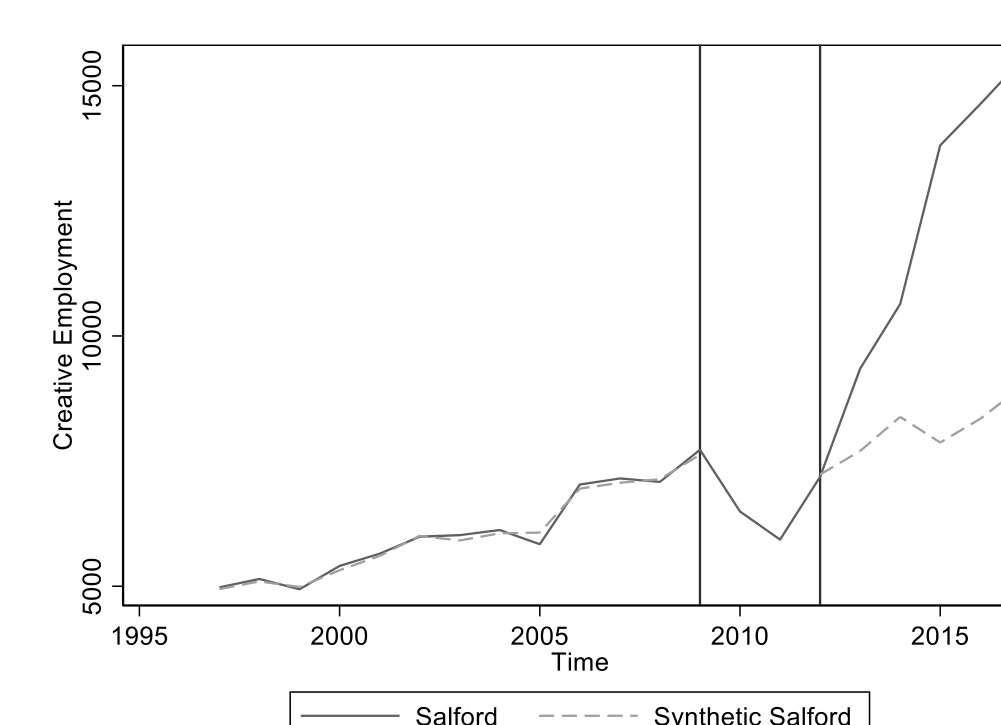
Line chart: creative employment in Salford rises above synthetic Salford after the BBC move
Creative employment, Salford vs synthetic Salford.
Working paper

Multipliers from a major public sector relocation: the BBC’s move to Manchester

with Y. Gómez-Hernández, H. Overman, C. Riom and M. Sánchez-Vidal · Funded by the ESRC

Revise and resubmit, Regional Science and Urban Economics

Each BBC job moved to Salford added around a third of a job in local creative industries, rising to 0.76 by 2017. But offsetting changes elsewhere left total employment unchanged.

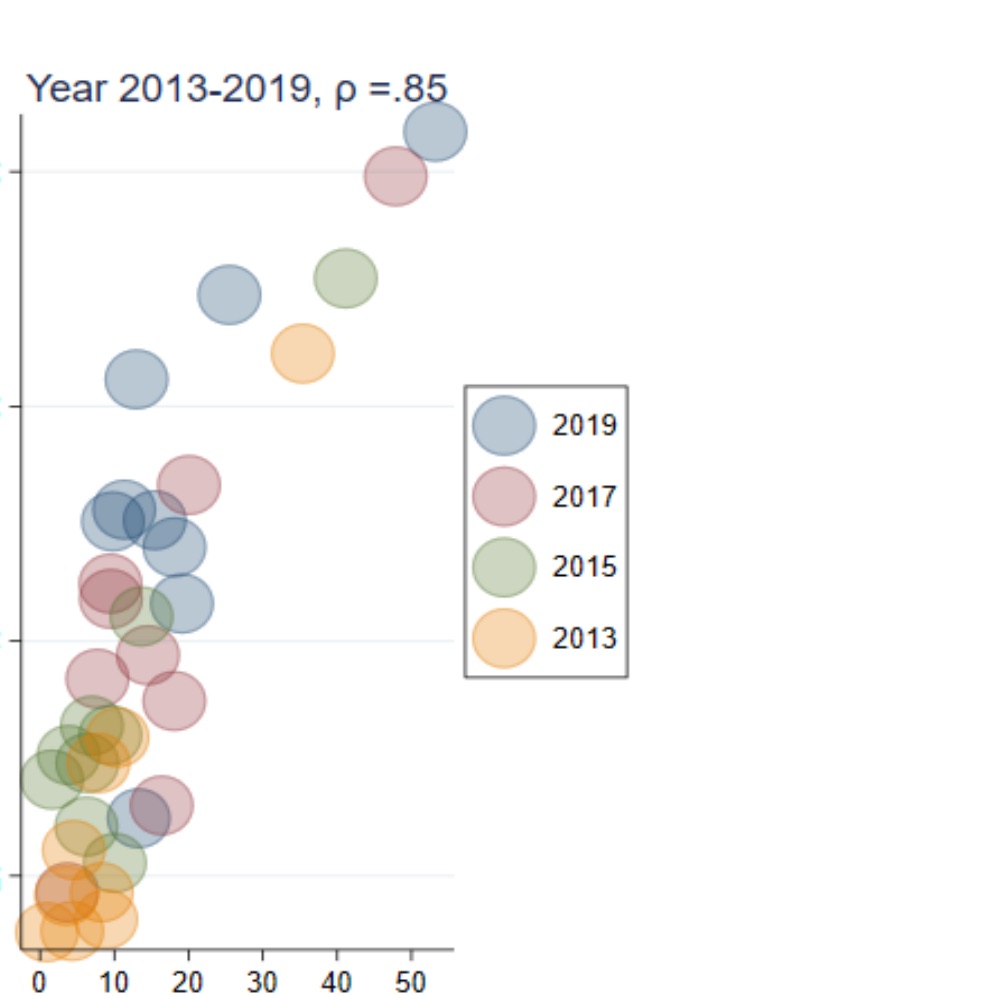
Bubble scatter plot of industry shares of firms buying cloud services against shares hiring cloud jobs, 2013 to 2019
Cloud adoption vs. cloud hiring by industry, 2013–2019.
Working paper

The New Wave: Technology diffusion in the UK during the 2010s

with M. Draca, V. Nguyen, J. Oliviera-Cunha, A. Rosso and A. Sivropoulos-Valero · Funded by the ESRC

Revise and resubmit, Research Policy

Cloud and ML/AI adoption in the 2010s is strongly biased towards STEM skills, concentrating it in high-tech places and firms.

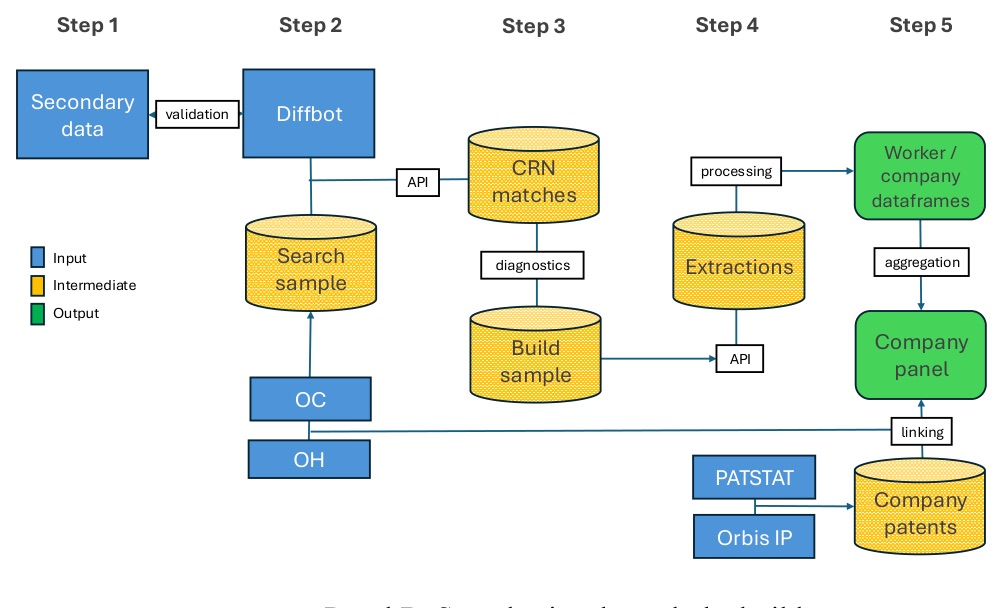
Flow diagram of the five-step GRAPH-EE workflow, from secondary data and Diffbot to worker and company panels
The GRAPH-EE build.
Working paper

GRAPH-EE: building employer-employee panels from company accounts and the public web

with S. Gray, T. Kemeny, C. Ozgen, G. Pialli, J. Reades, A. Rosso, M. Seré and A. Valero · Funded by the ESRC

Under review

A new employer-employee platform covering over 10,500 UK companies and 800,000 workers, 2007–2023, built from the public web and company microdata.

Abstract

Linked employer-employee datasets are a hugely powerful tool for researchers and policymakers across the social sciences. However, access to such data is typically highly restricted and the quality of data varies substantially across countries. This paper presents GRAPH-EE, a large-scale employer-employee platform for larger companies in the UK. Leveraging a vast knowledge graph of the global public internet linked to UK company microdata and global patents data, GRAPH-EE is a rich complement to administrative data sources. This version of the platform covers over 10,500 companies and 800,000 workers active in the UK during 2007-2023. We show the potential to extend our approach to multiple other countries.

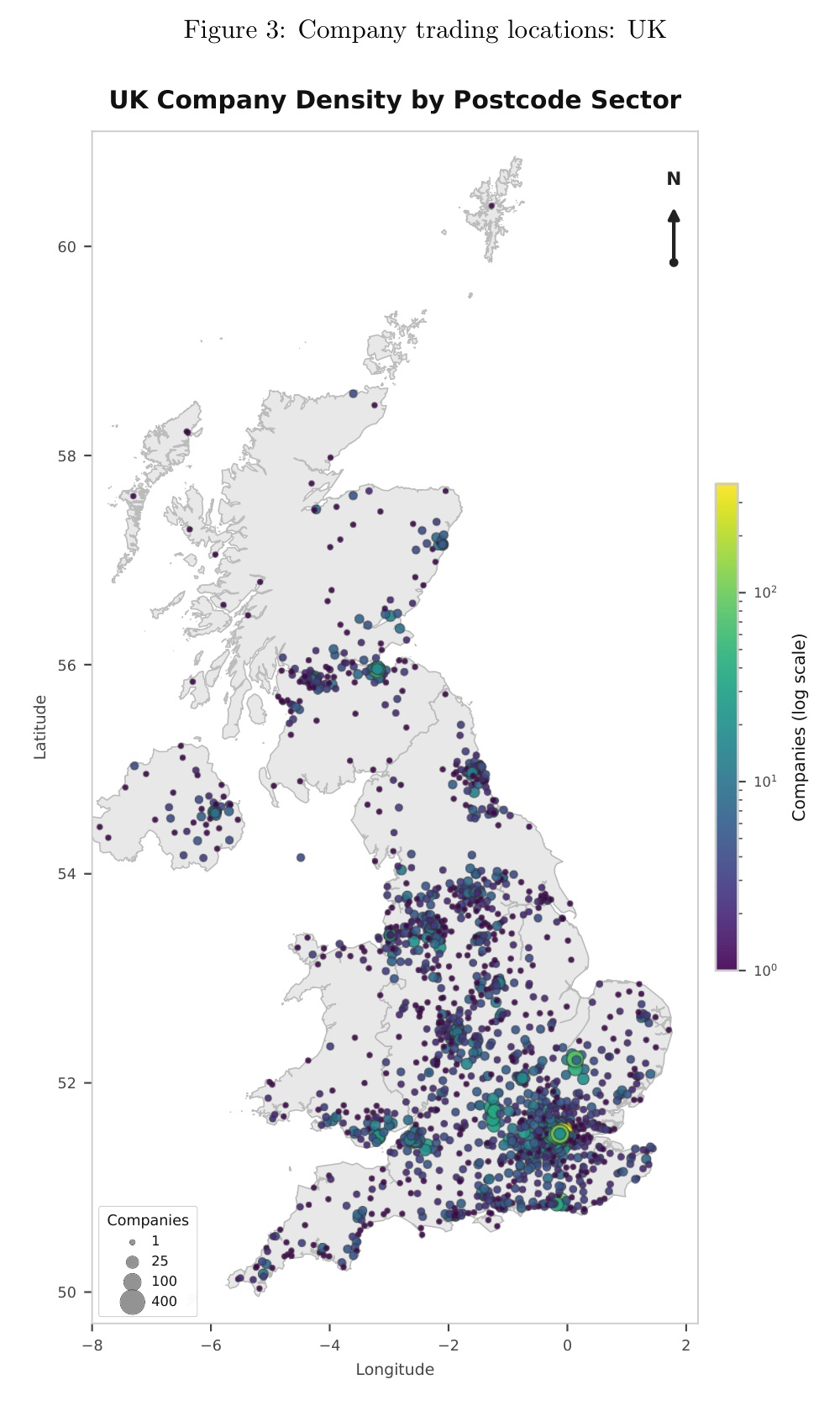
Map of UK company density by postcode sector
UK company density by postcode sector.
Working paper

Migrant Entrepreneurs, High-Growth Firms and Cities

with T. Kemeny, C. Ozgen, G. Pialli, A. Rosso, M. Seré and A. Valero · Funded by the ESRC

Migrants are over-represented among founders of UK high-growth firms. All-migrant and mixed founding teams grow faster by revenue than all-UK teams.

Abstract

This paper examines migrants’ role in founding high-growth firms and the urban nature of high-growth entrepreneurship. Although high-growth firms represent a small share of businesses in OECD countries, they disproportionately drive national economic activity. Using novel founder- and firm-level data on over 12,000 UK companies and 15,000 founders, we establish five new facts. First, relative to the UK’s migrant population, migrant entrepreneurs are substantially over-represented among founders of high-growth and high-growth-potential firms. Second, compared to UK-born founders, migrant founders are positively selected on human capital, but negatively selected on entrepreneurial experience. Third, high-growth potential firms are highly urbanised, and those with a migrant founder or co-founder display a distinctive urban geography different from migrants’ underlying spatial distribution. Fourth, firms with all-migrant and mixed native-migrant founding teams follow faster employment and revenue growth trajectories than all-UK teams. We find suggestive evidence of a ‘London bonus’ in employment growth for all-migrant founded firms. Fifth, as compared with firms founded by natives, firms with mixed native-migrant founding teams have more distinctive strategic positioning, with fewer peers.

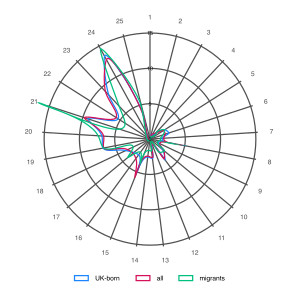
Bar charts comparing worker data with official statistics by industry, region, age, gender and education
Migrant vs. UK-born skills, 2023.
Working paper

Migration, diversity and firm performance

with T. Kemeny, C. Ozgen, G. Pialli, A. Rosso, M. Seré and A. Valero · Funded by the ESRC

Migrant workers bring distinctive and more complex skills, and migrant specialisation in technical roles is robustly linked to higher firm patenting.

Abstract

This paper documents the effects of migrant workers and migrant diversity on firms’ innovation and productivity. We build a novel matched worker-firm dataset leveraging over 500,000 online worker profiles alongside rich company microdata. Individual education and career histories are combined with large firms in the UK company register, plus detailed financial and patents data. To identify causal effects and underlying mechanisms, we implement placebo tests and instrumental variable strategies exploiting historical name patterns. We document three main findings. First, using our granular worker-level data, we show that migrant workers possess distinctive, and more complex skills than natives in the same jobs, especially in technical and STEM roles. Second, migrant specialization in technical occupations is robustly associated with higher firm-level patenting. Third, however, we find a positive but non-significant relationship between firm productivity and its migrant share, with larger magnitudes for highly educated migrants and in technology- and STEM-intensive firms. Together, these results highlight the skill composition and occupational allocation of migrants as key channels linking migration to firm performance.

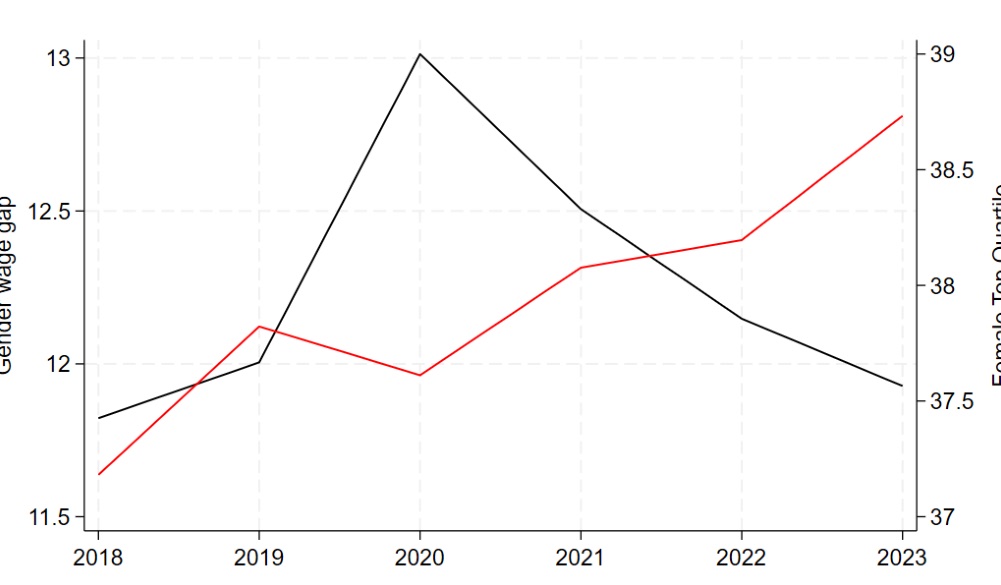
Line chart of the gender wage gap and female share in the top quartile for reporting firms, 2018 to 2023
Gender inequality indicators for reporting firms, 2018–2023.
Working paper

Should I Stay or Should I Go? The Impacts of the 2017 Gender Pay Gap Legislation on worker and firm outcomes

with T. Kemeny, C. Ozgen, G. Pialli, A. Rosso, M. Seré and A. Valero · Funded by the ESRC

Pay transparency raised job mobility among women, especially lower-paid, lower-skilled and non-managerial staff.

Abstract

This paper examines the effects of the UK’s 2017 gender pay transparency policy, which mandated large firms to disclose gender pay gap data. Using a novel employer-employee dataset and a difference-in-differences design around the treatment threshold, we find that the policy led to increased job mobility among women, especially low-skilled, in non-managerial roles and in the lower end of the wage distribution. Our findings suggest that transparency influences workforce composition, contributing to a narrowing of the gender pay gap—primarily through separation from women with weaker bargaining power. We conclude that policymakers should consider complementing pay transparency policies with other tools to avoid unintended consequences from such reforms.

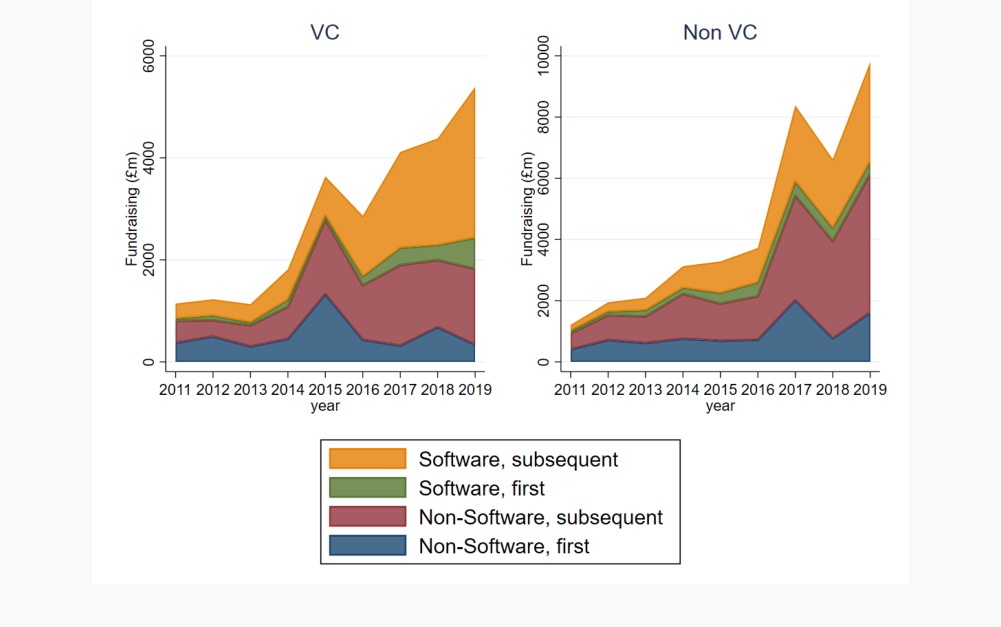
Stacked area charts of UK start-up fundraising by sector and round, VC and non-VC, 2011 to 2019
Start-up funding by sector and round, 2011–2019.
Work in progress

The Economics of Blitzscaling

with M. Draca, V. Nguyen, J. Oliviera-Cunha, A. Rosso and A. Sivropoulos-Valero · Funded by the ESRC

How venture funding for UK start-ups flows across rounds and sectors, with a heavy bias towards software.

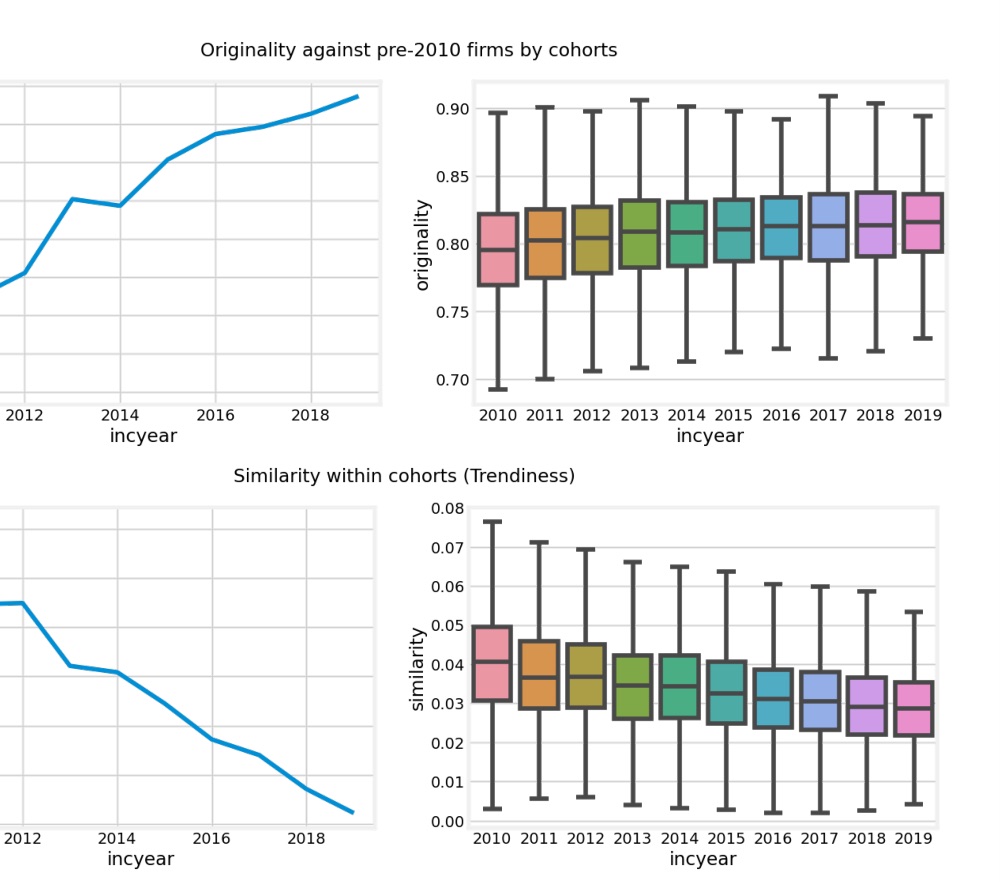
Charts of originality and within-cohort similarity of high-growth start-ups, 2010 to 2019
Originality and trendiness of high-growth start-ups by cohort.
Work in progress

Identifying Emerging Industries using text-based classification

with M. Draca, V. Nguyen, J. Oliviera-Cunha, A. Rosso and A. Sivropoulos-Valero · Funded by the ESRC

Using company descriptions to spot emerging industries that slower official classifications tend to miss.

Published articles

Books & chapters